
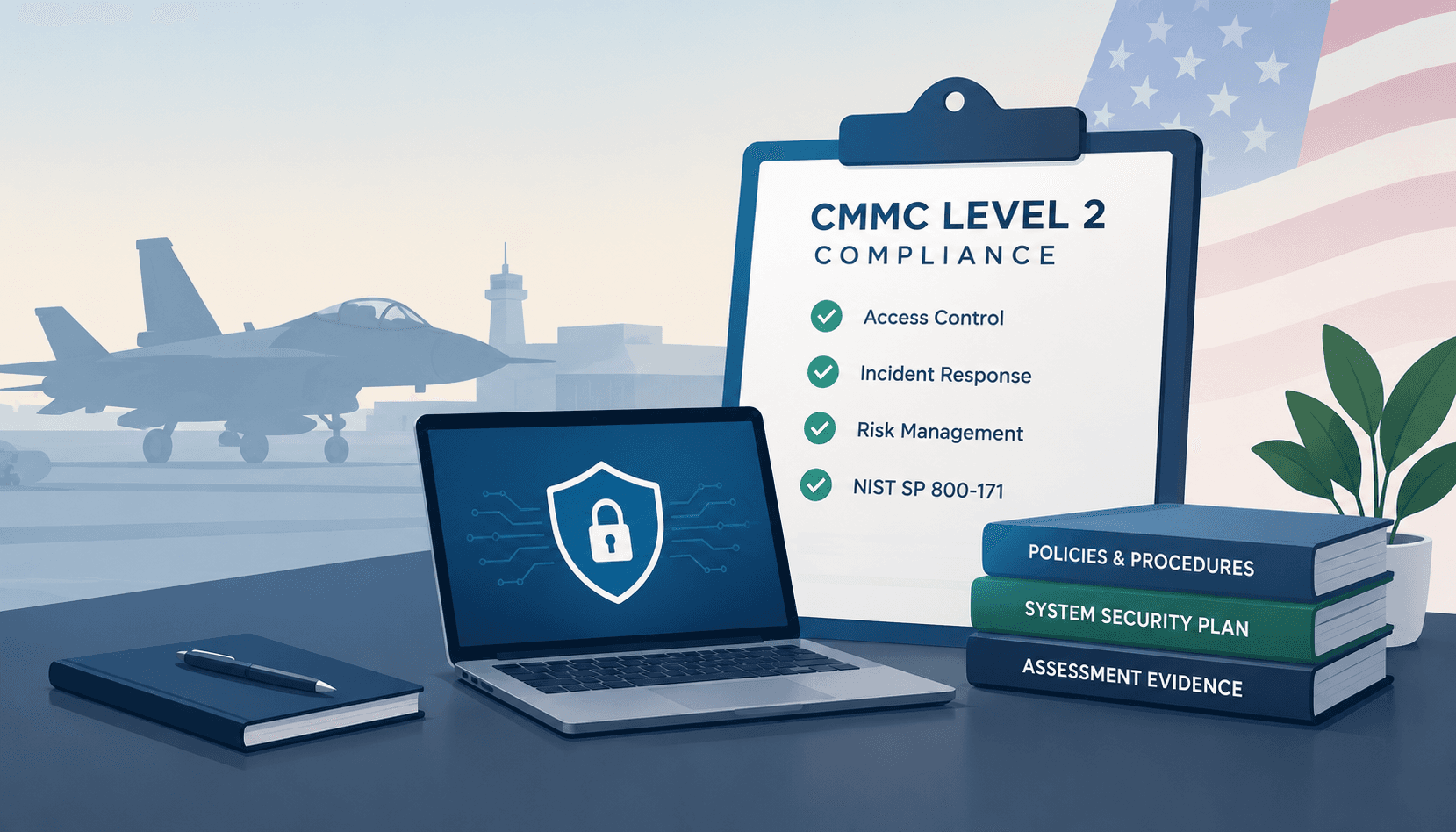
Cybersecurity is a critical requirement for businesses working with the U.S. Department of Defense (DoD). Defense contractors and subcontractors often handle sensitive government information, making strong security controls essential. The Cybersecurity Maturity Model Certification (CMMC) program was developed to help verify that these businesses implement the required cybersecurity protections.
For companies working in the Defense Industrial Base (DIB), understanding CMMC Level 2 compliance is particularly important. Knowing the applicable requirements, assessing current security practices, and addressing gaps can help businesses protect sensitive information and prepare for contract requirements.
What Is CMMC Level 2?
CMMC stands for Cybersecurity Maturity Model Certification. It is a U.S. Department of Defense program designed to verify that defense contractors and subcontractors adequately protect Federal Contract Information (FCI) and Controlled Unclassified Information (CUI).
CMMC Level 2 focuses on protecting CUI, which includes sensitive government information that requires safeguarding but is not classified. Examples may include technical drawings, engineering specifications, and certain contract-related information.
Level 2 is aligned with the 110 security requirements in National Institute of Standards and Technology (NIST) Special Publication 800-171 Revision 2. These requirements cover areas such as access control, incident response, system security, and risk management.
The goal is to ensure that organizations handling CUI have appropriate security measures in place and can demonstrate their implementation.
Why Does CMMC Level 2 Compliance Matter?
For defense contractors, cybersecurity compliance is closely connected to contract eligibility and supply chain security.
Protecting sensitive information: Effective security controls help reduce the risk of unauthorized access, data theft, and cyberattacks targeting defense-related information.
Meeting contract requirements: Applicable DoD contracts may specify a required CMMC status. Organizations must understand the requirements associated with their contracts and the information systems used to perform them.
Maintaining supply chain relationships: Prime contractors may need to ensure that subcontractors handling sensitive information meet the relevant cybersecurity requirements. Smaller suppliers should therefore understand their obligations before accepting work involving CUI.
Demonstrating security readiness: Documented security practices and reliable assessment evidence help organizations demonstrate that cybersecurity is being managed systematically rather than informally.
CMMC compliance is therefore an important consideration for businesses that want to protect their systems while continuing to pursue defense-related opportunities.
What Are the Main CMMC Level 2 Requirements?
CMMC Level 2 draws on NIST SP 800-171 Revision 2, which contains 110 security requirements across 14 control families.
Key areas include:
- Access control: Restricting system access to authorized users and approved activities.
- Identification and authentication: Verifying user identities before granting access.
- Audit and accountability: Recording and reviewing system activity to help identify suspicious behavior.
- Incident response: Establishing procedures to detect, report, and respond to cybersecurity incidents.
- Risk assessment: Identifying security threats and evaluating potential weaknesses.
- System and communications protection: Protecting information as it moves through networks and systems.
- Security assessment: Evaluating whether implemented controls meet applicable requirements.
Organizations must also maintain supporting documentation, including system security plans and evidence that relevant controls have been implemented.
The precise requirements depend on the assessment scope and the systems that process, store, or transmit CUI. Businesses should consult the official CMMC guidance to determine which requirements apply to their circumstances.
How Can a Business Prepare for CMMC Level 2?
Preparing for CMMC Level 2 requires more than purchasing cybersecurity software. Businesses need to understand their existing environment, identify gaps, implement appropriate controls, and maintain evidence of compliance.
1. Identify Where CUI Is Handled
Start by determining which business processes, employees, applications, devices, and networks handle Controlled Unclassified Information. Defining this environment helps establish the scope of the compliance effort.
2. Conduct a Gap Assessment
Compare existing security practices against the applicable NIST SP 800-171 requirements. Identify controls that are missing, partially implemented, or unsupported by sufficient evidence.
3. Develop a System Security Plan
A System Security Plan (SSP) describes the information system, its boundaries, and how the organization implements its security controls. It should accurately reflect the organization's actual environment.
4. Address Security Gaps
Prioritize weaknesses according to their risk and compliance implications. Depending on the findings, improvements may involve stronger authentication, better access restrictions, improved monitoring, updated procedures, or additional technical safeguards.
5. Maintain Documentation and Evidence
Keep relevant policies, procedures, assessment records, and implementation evidence organized and up to date. Documentation should demonstrate how security requirements are satisfied in practice.
6. Verify the Applicable Assessment Requirements
CMMC assessment obligations depend on the contract, required level, and applicable program rules. Organizations should confirm whether a self-assessment or another assessment method is required and ensure that their compliance status is properly recorded.
What Is the Current CMMC Status in 2026?
CMMC implementation is evolving, so contractors should follow official announcements rather than rely on outdated implementation timelines.
On July 13, 2026, the Department of Defense announced a suspension of the planned Phase II requirements while it reviews the program. Phase I self-assessment requirements remain in place. The department also stated that NIST SP 800-171 Revision 2 requirements continue to apply through relevant cybersecurity obligations.
This distinction matters: a pause in the rollout of additional CMMC requirements does not eliminate existing contractual cybersecurity responsibilities.
Defense contractors should review current DoD guidance, applicable contract clauses, and their specific assessment obligations before making compliance decisions.
How Can CMMC Compliance Tools Help?
Managing CMMC requirements manually can become difficult as businesses accumulate security policies, assessment findings, technical evidence, and remediation tasks.
CMMC compliance tools can help organizations organize requirements, track implementation progress, document security controls, and identify areas requiring attention. Depending on the solution, these tools may also support readiness assessments, evidence management, and ongoing compliance workflows.
However, software alone does not establish compliance. Organizations must implement the required safeguards, maintain accurate documentation, and verify that their systems meet the applicable standards.
Final Thoughts
CMMC Level 2 compliance is an important cybersecurity consideration for defense contractors handling Controlled Unclassified Information. Understanding NIST SP 800-171, defining the relevant systems, addressing security gaps, and maintaining reliable documentation can help businesses build a stronger compliance foundation.
Because program implementation and contract requirements can change, organizations should verify the latest official guidance before committing to an assessment timeline. A structured approach to cybersecurity readiness can help defense contractors manage risk and prepare for their applicable compliance obligations.